At Hannover Messe 2026, Wandelbots presented a live demonstration showing how simulation, AI, orchestration, and physical automation systems can operate within one connected production workflow.
Rather than focusing on a narrowly industry-specific use case, the demonstrator was intentionally designed as an abstract automation scenario applicable across different manufacturing environments.
An AGV delivers randomly positioned cubes into a collection bin, from which the robots can pick them up. A 3D vision system scans the scene, AI identifies cube positions and visible letters, and multiple robots coordinate in real time to assemble randomly selected words such as ADAPT, DATA, ACT, or AI.
The demonstrator showed how AI-based perception, simulation environments, and orchestration software can be integrated into a unified operational workflow spanning both digital and physical production systems.
Embedded in the video below is one complete production cycle recorded live at the booth:
A Continuous Operational Loop Instead of a Static Automation Cell
Traditional automation systems are often designed around fixed assumptions:
-
predefined positions
-
predictable workflows
-
isolated machines
-
vendor-specific logic
-
manual intervention during faults or downtime
The demonstrator introduced variability directly into the process.
-
Cube positions changed continuously.
-
Word selection changed dynamically.
-
Gripping situations varied from cycle to cycle.
-
AGV downtime scenarios became part of the workflow logic.
-
Multi-vendor hardware operated natively under a unified Python platform via Wandelbots NOVA OS
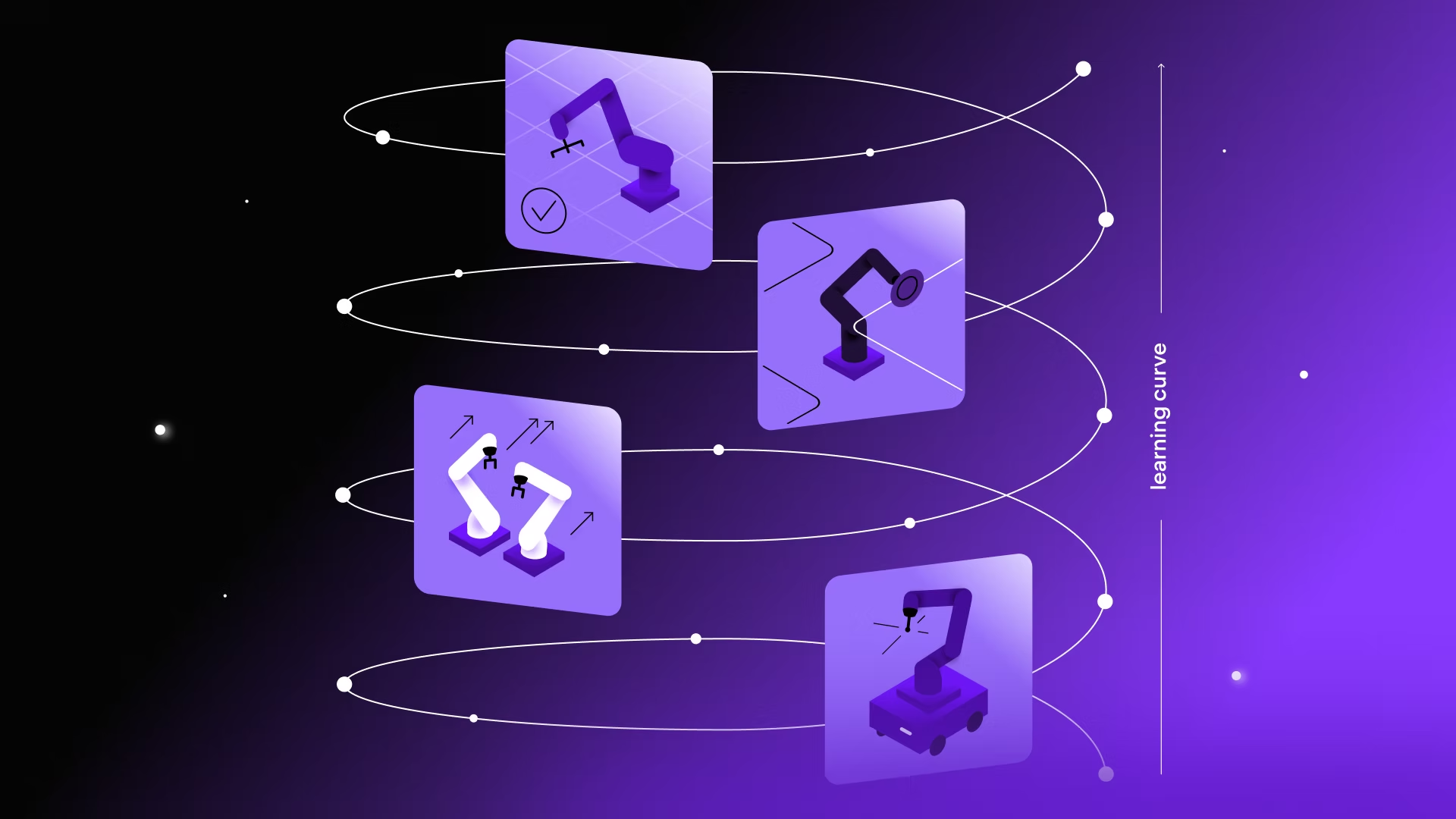
Instead of treating these situations as exceptions, the system was designed to adapt to them in real time through a continuous operational cycle built around four connected phases.
1. Sense
Robots, sensors, cameras, IPCs, and the AGV continuously stream information into the system. The 3D vision setup detects cube positions and visible letters in real time while AI models classify and interpret the scene before execution begins.
This allows the workcell to react dynamically to physical variability instead of relying on rigid positioning assumptions.
During the demo, the system continuously adapted to:
-
Randomly scattered cube positions
-
Changing target words
-
Varying gripping orientations
-
Runtime workflow changes
-
AGV downtime situations
One particularly important scenario demonstrated operational resilience: if the AGV became unavailable, the robots automatically bypassed the AGV workflow and continued operation through direct robot-to-robot handovers without requiring manual intervention.
Instead of stopping the workflow, the orchestration layer rerouted execution dynamically.
2. Think
Before execution happens on the physical system, workflows are simulated and validated in a digital environment.
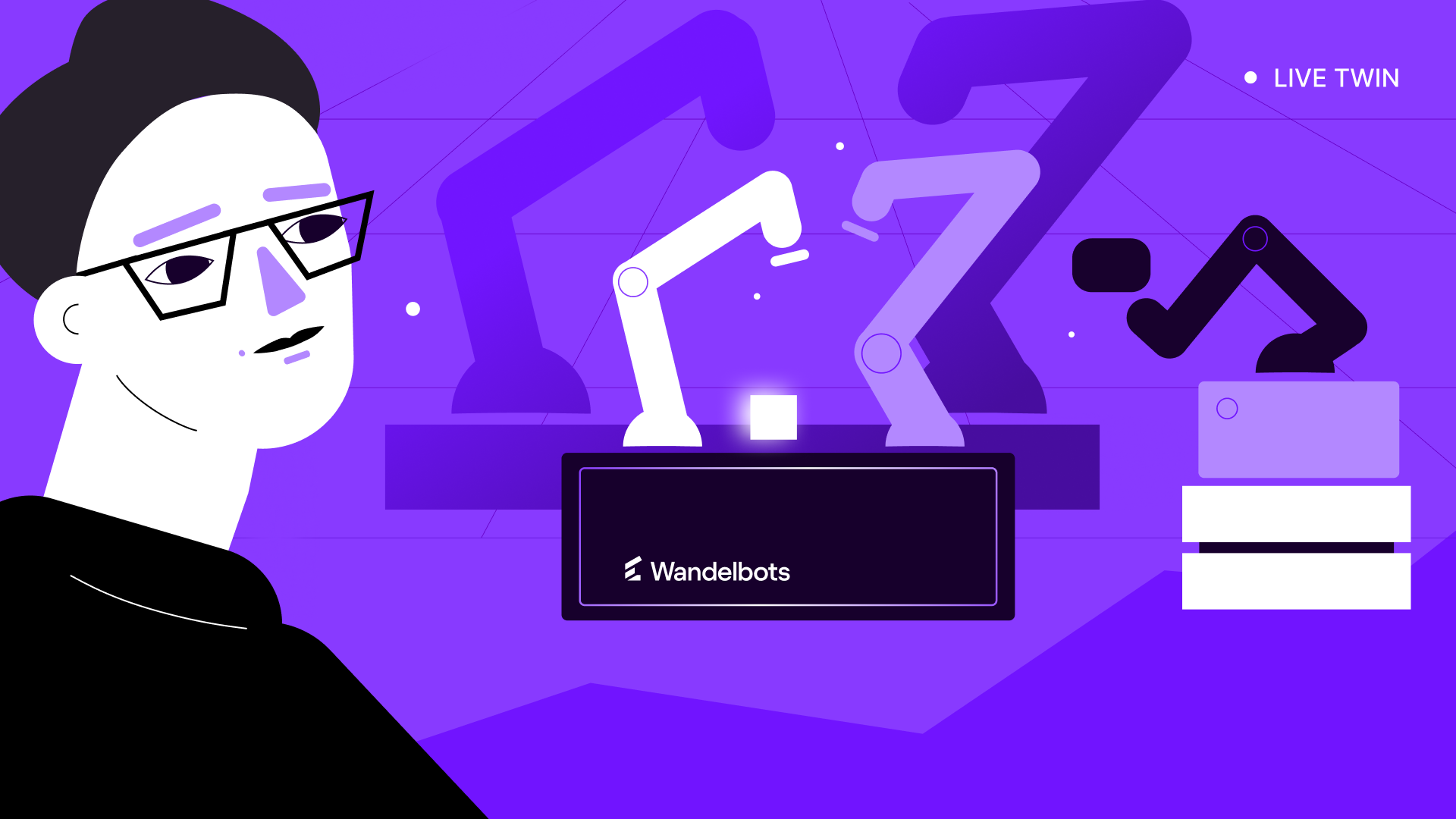
The complete demonstrator exists as a digital twin in NVIDIA Omniverse, where robot behavior, workflows, and AI-driven processes can be tested before deployment into the live cell.
Vision models are initially trained using synthetic data inside simulation environments and then refined using operational feedback from the real system.
At Hannover Messe, visitors could see this directly: while the physical production process executed on the booth floor, a live simulation of the same workflow ran simultaneously in the background.
The demonstrator combined four connected layers:
-
The physical automation cell
-
The digital twin in NVIDIA Omniverse
-
AI training workflows using synthetic data
-
Operational orchestration through Wandelbots NOVA
The purpose is to reduce the gap between planning, validation, deployment, and continuous optimization.
3. Act
Once validated, workflows are executed directly through Wandelbots NOVA across heterogeneous automation systems.
In this demonstrator, a single Wandelbots NOVA instance orchestrated:
-
The GESSbot AGV
-
Yaskawa robots
-
KUKA robots
-
AI-powered vision systems
-
External IPCs
-
Runtime workflow execution
Wandelbots NOVA acted as the central orchestration and communication layer connecting all operational components into one coordinated system.
This is especially relevant in environments where manufacturers operate mixed hardware ecosystems instead of relying on a single vendor stack.
AI-based detection itself ran locally on-device to enable low-latency execution, while broader AI pipelines could operate either cloud-based or fully on-premise depending on production requirements.
The result is an architecture where orchestration logic, AI services, simulation environments, and physical execution can remain modular while still operating as one connected production system.
4. Improve
The final phase closes the operational loop.
Because Wandelbots NOVA acts as the unified operational backbone, live troubleshooting and operational maintenance become integrated parts of the production workflow rather than isolated engineering tasks.
Centralized logging and observability allow operators and engineers to:
-
identify failures quickly
-
inspect runtime behavior
-
isolate affected components
-
restart or manage individual Kubernetes pods when necessary
This modular architecture improves robustness while maintaining centralized orchestration across the entire system.
At the same time, operational data continuously flows back into the system to improve future execution cycles.
Real production feedback helps optimize:
-
AI detection quality
-
motion handling
-
orchestration logic
-
runtime robustness
-
operational stability
Importantly, these improvements happen without rebuilding the entire application stack from scratch.
What the Demonstrator Actually Represents
This demo goes beyond showcasing a single robotic task. It illustrates how Physical AI can connect simulation, orchestration, perception, and runtime execution into adaptable production environments where:
-
Applications become portable across hardware environments
-
Simulation and production stay continuously connected
-
AI models improve through operational feedback loops
-
Orchestration becomes hardware-agnostic
-
Production systems become adaptable instead of static
The result is an automation approach that can scale beyond isolated demo cells into repeatable operational frameworks for real manufacturing environments.
Thank You to Our Partners
This demonstrator was made possible through collaboration with multiple partners across robotics, AI, simulation, gripping technology, and industrial infrastructure.
A big thank you to all partners involved in bringing this demonstrator to life at Hannover Messe: Ensenso, Gessmann, KUKA, NVIDIA Omniverse, Schmalz, Schunk, Vathos, Yaskawa, Zimmer Group
.webp)